
Why logging into OKX is more than a password: a trader’s practical guide
Surprising statistic to start: OKX now claims service to over 100 million users worldwide, yet for a US-based trader the single most consequential moment on the platform is often the login—because that’s where custody, regulatory identity, and attack surface meet. Logins are not merely authentication events; they are the hinge between self-custody and centralized custody, between on-chain transparency and off-chain controls. This article walks a crypto trader through the mechanics, trade-offs, and everyday decisions when signing in to the OKX exchange, and it does so from the concrete case of a US user preparing to place spot, margin, or derivative trades.
We use the login process as a case study to show how OKX’s technical choices — mandatory KYC, 2FA, PoR commitments, and a hybrid CEX/Web3 product design — affect usability, security, and regulatory exposure. You will get a clearer mental model of where things can break, what steps reduce your risk most effectively, and what signals to watch next if you trade actively in the US market.
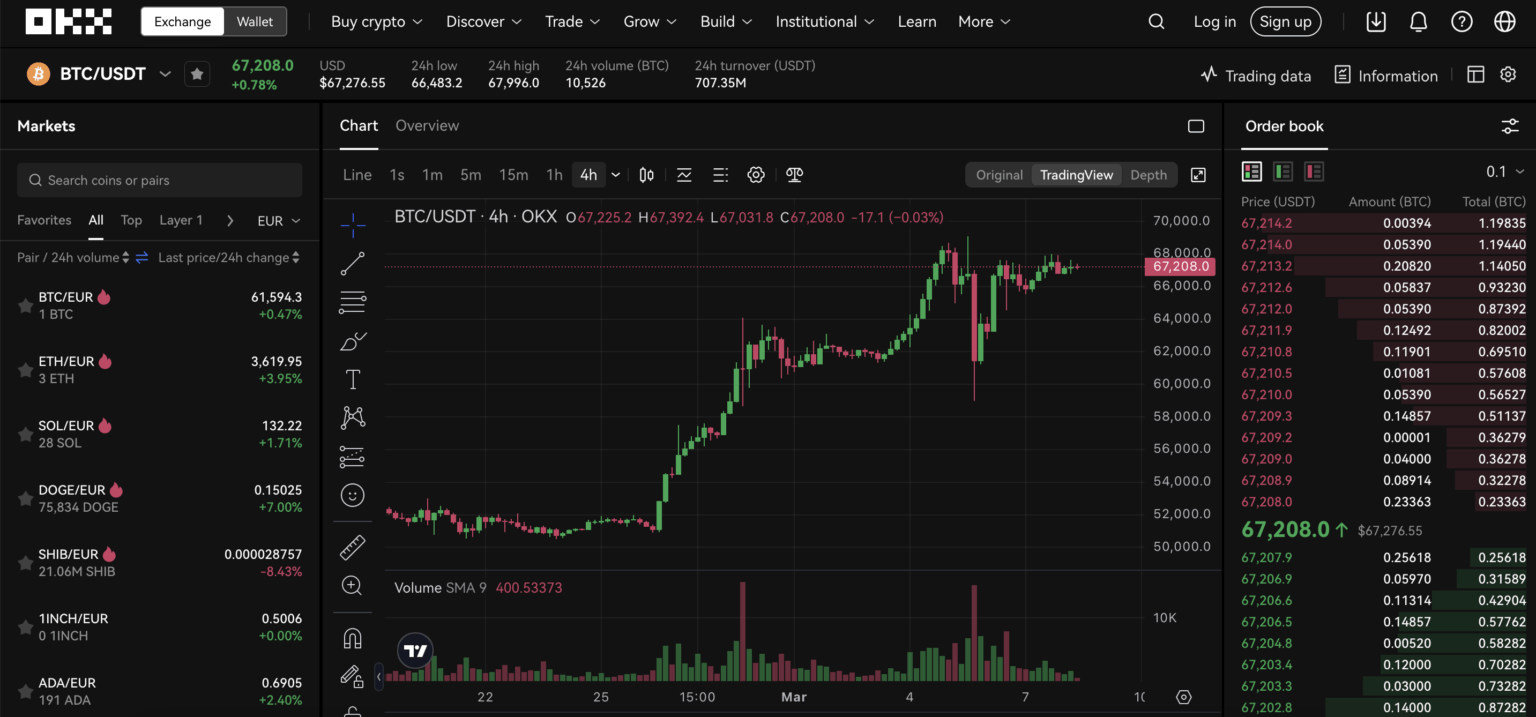
How OKX’s login works — mechanism, not magic
At a functional level, signing in to OKX ties three systems together: your identity, your session/device, and your custody modality. Identity is verified through KYC in the onboarding phase — in the US that means a government ID and a liveness check — which affects what products you can use. Session management is protected by strong encryption and AI-driven threat detection that monitors for anomalous logins. Custody is the user-side choice: either keep funds on the centralized exchange or interact via OKX’s non-custodial Web3 wallet (seed phrases, hardware integrations). Each of these components imposes different risks and responsibilities.
Concretely, the platform enforces Two-Factor Authentication at login (SMS, Google Authenticator, or biometrics on mobile). For US traders, biometric mobile login is fast and strong, but it pairs convenience with device dependence: lose access to the phone and you may face a slow recovery funnel. If you want a quick walkthrough to the sign-in page and options, follow this practical link for the web interface: okx login.
Trade-offs: convenience, custody, and regulatory constraints
Three trade-offs recur for active traders. First: speed vs. redundancy. Biometric and app-based logins are fast; hardware-backed keys and separate authenticator apps are slower but remove single points of failure. Second: centralized convenience vs. non-custodial control. Keeping assets on OKX’s CEX simplifies staking, margin, and derivatives participation (including up to 125x leverage on certain products), but it centralizes counterparty risk. Third: regulatory compliance vs. privacy. KYC unlocks full trading features and fiat rails in the US, but it ties your identity to on-chain and off-chain flows — a fact that matters if you prefer pseudonymity.
Understanding these trade-offs helps decide how to structure your entry-exit behavior. For example, if you frequently use futures or high-leverage margin (up to 10x isolated or cross-margin on spot-margin bridges, and up to 125x on specific perpetuals), you may accept custody with OKX and prioritize quick, device-based logins. If you’re primarily staking, yield farming, or using the integrated NFT marketplace and DeFi hub across 130+ blockchains, you might prefer the self-custodial wallet and hardware sign-in flows to separate custody and reduce counterparty exposure.
Where it breaks: realistic failure modes
No system is invulnerable. For OKX the main failure modes are human and ecological rather than purely cryptographic: phishing attacks that capture credentials before 2FA, device loss that prevents biometric or SMS recovery, and social-engineering attacks aimed at KYC re-verification. On the DeFi side, smart contract exploits remain a material risk whenever you interact with yield farming or third-party DeFi protocols aggregated through the OKX DEX.
Proof of Reserves (PoR) reduces the counterparty solvency concern by providing on-chain evidence that deposited assets are held; however PoR is not the same as insurance against hacks or operational failure. PoR demonstrates backing at a point in time and increases transparency, but it does not prevent theft or guarantee instant recoveries for individual losses. Likewise, cold storage (over 95% of assets offline) lowers large-scale hacking risk but does not eliminate targeted account takeovers enabled via compromised credentials.
Practical checklist for a safer OKX sign-in
Apply this simple, decision-useful framework every time you prepare to log in:
- Device hygiene: use a dedicated device for trading if you trade actively; keep OS and browser up to date.
- 2FA best-practice: prefer an app-based authenticator to SMS; register a hardware wallet for withdrawals or non-custodial operations.
- Session scrutiny: confirm unusual login alerts with the device you normally use before approving resets or re-verifications.
- Recovery redundancy: store KYC and recovery proofs securely offline; for self-custodial wallets, maintain multiple encrypted backups of seed phrases, ideally using hardware wallets like Ledger/Trezor integrations OKX supports.
- Small-bucket custody: keep only trading capital on the exchange; long-term holdings are safer in cold or self-custodial storage.
How the product mix shapes trader behavior — mechanism to market
OKX is more than a spot exchange: it bundles a CEX, a Web3 wallet, an NFT marketplace, and a DEX aggregator. Mechanically, that encourages multi-modal behavior — a trader might move a token from a cold store into OKX to swap via the DEX aggregator, stake it, and then place a leveraged trade without switching platforms. This convenience lowers friction but increases the surface area exposed to centralized controls and smart contract risk. For US traders, that means decisions about where to hold assets are also decisions about which safeguards and regulatory constraints apply.
Two non-obvious implications follow. First, integrated product stacks favor traders who practice compartmentalization: segregate funds by purpose (staking funds vs. active margin capital) and by custody model (CEX custody vs. self-custodial). Second, watch liquidity and slippage: using the DEX aggregator can reduce swap costs by routing across Uniswap and others, but low-volume assets still carry wide spreads and execution risk — a mechanical constraint that no aggregator fully removes.
What to watch next (near-term signals)
Three signals will matter for US traders in the near term. One: regulatory updates that change KYC or AML requirements could alter onboarding friction or product availability; because OKX already enforces KYC, U.S. changes will more likely affect product sets than the basic login. Two: changes in product leverage or risk controls (e.g., adjusting max leverage on certain perpetuals) will directly affect how aggressively traders use the platform after logging in. Three: enhancements to PoR frequency or transparency methods would raise confidence in exchange solvency but won’t eliminate account-level theft risks.
If you trade derivatives, watch margin rules and liquidation engine changes; if you yield-farm, monitor audits and protocol insurance coverage. These are conditional signals — they matter because they alter the balance between reward and counterparty or smart-contract risk.
Frequently asked questions
Is OKX safe to log in to from the US?
Safety is relative. OKX uses strong encryption, AI-driven threat detection, mandatory 2FA, and stores most funds in cold wallets. For US users, the practical risk is account-level compromise (phishing, device loss) and external DeFi exploit risk when moving funds. Use app-based or hardware 2FA, keep recovery data offline, and segregate funds by custody model to reduce exposure.
Should I use the Web3 wallet or keep funds on the exchange?
It depends on purpose. If you need immediate access to margin and derivatives, keeping a trading balance on the exchange is practical. For long-term holdings or interactions with risky DeFi contracts, the self-custodial wallet with hardware backups gives stronger protection against exchange-level operational risks. A hybrid approach — small active balance on the CEX and the remainder in self-custody — is a common heuristic.
How does Proof of Reserves affect my login or holdings?
PoR increases transparency about whether the exchange’s liabilities match assets on-chain. It’s a systemic solvency signal, not a preventive control against individual account compromise. Continue to follow strong account-security practices even if PoR reports are positive.
What should I do if I lose access to my 2FA device?
Follow OKX’s official recovery process, but expect delays: identity re-verification and manual checks are common for high-value accounts. This is why multi-backup strategies (authenticator backup codes stored offline, hardware key registrations) are recommended before you need them.
Final takeaway: the moment you click “Sign In” is a decision node with cascading consequences. Treat login choices as part of your risk budget — choose methods that align with how you trade (active margin trader vs. long-term staker), and enforce simple hygiene rules that dramatically reduce the chance of account loss. As the ecosystem blends CEX and Web3 in a single interface, the best traders will be those who can rapidly move across custody models while keeping a strict partition between trading capital and long-term assets.